
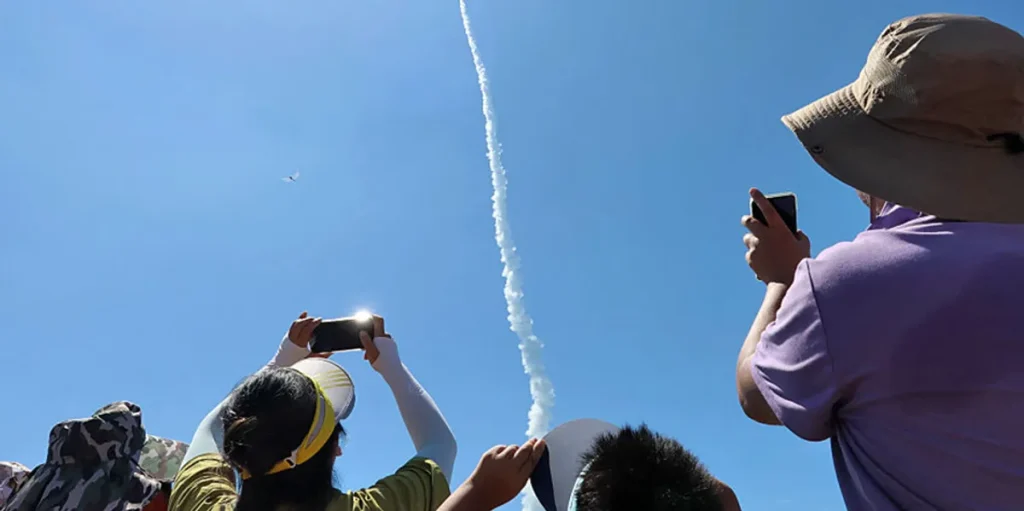
China has postponed its Chang’e‑7 mission to the Moon’s south pole until at least 2027. The China National Space Administration (CNSA) announced the delay after a planned late‑August launch window, with no official reason given.
Target: Shackleton crater
The mission—comprising a lander, rover, and mobile probe—had been aimed at the Shackleton Crater region, where permanently shadowed areas could harbor water ice, according to the source article.
What Beijing said
CNSA stated, via a translated announcement cited in the article: “Based on the principles of safety, reliability, and infallibility, after comprehensive analysis and judgment, the Chang’e‑7 mission does not meet the launch conditions and cannot be implemented in the scheduled window this year.”
Storm reports and a missed window
No cause was provided by officials. However, The Straits Times reported that Typhoon Narra and flooding displaced tens of thousands in China, including more than 8,000 people moved to emergency shelters. Ars Technica, citing a typhoon warning center, reported the storm was expected to persist for several days—conditions that could prevent launches at China’s Wenchang site and prompt a missed window.
Timelines and stakes
The article said Chang’e‑7 was a crucial first step for China’s broader lunar plans, with Chang’e‑8 targeted for 2029 and a crewed lunar mission in 2030. It also said Beijing previously described its space station as “steadily in orbit” to support future crewed landings.
On the U.S. side, the article stated that after Artemis II, Artemis III has a 2027 window to test systems and monitor the lunar surface, with Artemis IV targeting “early 2028” for a Moon landing to establish a sustained presence.
Washington’s response
At the time of the cited report, the article said the United States government had not publicly commented on China’s delay.